
How Many Hotels Have a Wikipedia Page? Hotelrank’s 2025 Wikipedia Footprint Study
Hotelrank’s 2025 deep dive into how many French hotels actually have a Wikipedia page (just 2.4%), why they’re mostly palaces and landmarks, and what this bias means for SEO and AI visibility.
AI and SEO expert at the forefront of AI Search. He analyses models daily and runs hospitality-focused experiments on a database of over 1M prompts, citations and mentions.
AI Loves Wikipedia. Hotels… Not So Much
ChatGPT, Gemini, Perplexity, Claude and friends absolutely LOVE Wikipedia.
In most “top cited domains” studies, Wikipedia is either #1 or #2 as a source for LLM answers – usually alongside Reddit. See the study from Semrush below.
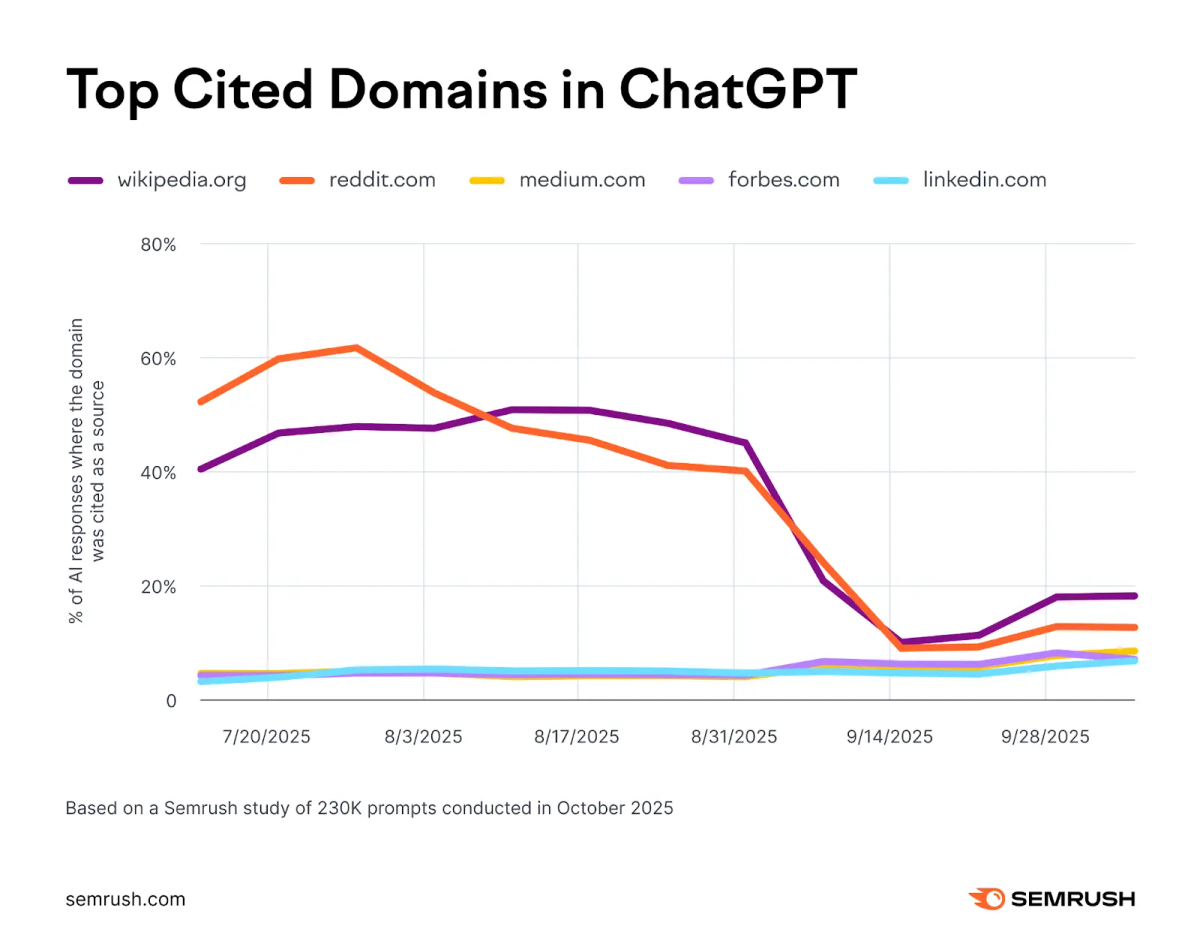
But when you zoom into hotels, there’s a weird mismatch:
AIs rely heavily on Wikipedia.
BUT lmost no hotels actually live there.
This post is about that gap, why it exists, and what it really means for hotel SEO / AEO – and what it doesn’t mean.
What AIs Actually Cite
Wikipedia & Reddit are over-represented in AI answers
Independent studies (Semrush on ChatGPT citations, Profound on AI search in general, soon Hotelrank.ai hehe) all point in the same direction:
- wikipedia.org and reddit.com dominate as cited domains
- Long tail of “normal” web content appears much less often
- This pattern holds across many verticals, not just tech
When you run your own prompts, you see it too.
Ask for “history of X”, “explain Y”, or “compare Z” and Wikipedia appears in:
- The citations at the bottom
- The background facts the model uses
- Sometimes, almost word-for-word phrasing
So, if you’re doing Answer Engine Optimization (AEO), it’s natural to ask:
“Should I get my hotel on Wikipedia so AIs see me?”
Let’s look at the numbers first.
How Many French Hotels Have a Wikipedia Page?
The 2.4% datapoint
I started with the official list of 15,155 hotels in France (INSEE classification).
Then I:
- Cross-referenced them with Google Maps
- Cleaned obvious junk and outliers
- Missing websites
- No real address
- Almost no reviews (<10, sorry for new hotels), etc.
- Looked for matching Wikipedia pages or references using Gemini 3, the Google Knowledge Graph (hotels all have a place_id) and iterated a bit on my prompt.
ChatGPT loves Wikipedia. Hotels? Not so much.
Result:
- 366 hotels had their own Wikipedia page or a clear Wikipedia entity
- That’s 2.4% of the official hotel stock
- So 97.6% of hotels basically don’t exist in one of AI’s favourite sources
You can run as many ChatGPT prompts as you like – the overwhelming majority of real hotels simply are not there as first-class pages.
Why So Few Hotels Make It to Wikipedia
Wikipedia is not a directory
The key point:
Wikipedia is an encyclopedia, not a listing site.
To get a standalone page, a hotel needs to meet Wikipedia’s notability guidelines. In practice, that means:
- Significant coverage The hotel must be discussed in depth (not just a “best hotels in X” listicle or a line in a guide).
- Reliable, editorial sources Think major national / international newspapers, respected industry journals, academic books – with real fact-checking.
- Independent sources No PR. No brochureware. No self-published content. The hotel’s own site doesn’t count.
Most hotels – even great, commercially successful 3★ and 4★ properties – never get that level of independent coverage.
Who actually gets a page?
Looking at the French sample, the hotels that do show up on Wikipedia fall into a few buckets:
- Historic grand hotels and palaces Flagship 5★ properties, often part of the urban fabric or national heritage.
- Architectural or heritage landmarks Castles, protected buildings, converted monasteries, iconic modern architecture, etc.
- Hotels tied to major events Political summits, historic treaties, famous crimes, scandals… sometimes very “Godwin-adjacent”...
- Highly niche concepts Things like hotel barges, naturist resorts, very specific thematic concepts.
And then there’s a whole grey zone:
- Hotels mentioned within a brand page (e.g. the chain’s article)
- Hotels appearing inside a city or neighborhood article (“this hotel is located on…”)
- Hotels mentioned in articles about battles, wartime events, or social controversies, where the hotel is just the venue.
In other words:
The hotels that make it to Wikipedia are not representative of the hotel market.
They’re the outliers: historic, luxurious, quirky, or historically loaded.
The Visibility Gap for AI & AEO
“Wikipedia hotels” may be over-represented in AI answers
If Wikipedia is a primary source for LLMs, and only 2.4% of hotels have a page, then those hotels are likely over-weighted in AI answers versus the long tail.
You can see hints of this in real prompts:
- Ask ChatGPT for “best 5-star hotels in Paris”
- You’ll often see palaces and iconic names repeated across answers and personas
- These are exactly the kind of hotels that tend to also have Wikipedia pages
This doesn’t mean the model is only reading Wikipedia, but the bias is there:
- A tiny group of “Wikipedia hotels” get extra visibility
- The rest of the market is almost entirely invisible through that channel
Why this matters for Answer Engine Optimization
For hotels, GEO (geographic SEO) and AEO (answer engine optimization) are about:
- Being discoverable in AI answers
- Being eligible for recommendation
- Being chosen among alternatives
If your content doesn’t exist where the model looks, you’re simply not in the race.
Wikipedia is one of those places.
But it’s not the only one – and it’s not the most realistic lever for 97%+ of hotels.
Should Hotels Have a “Wikipedia Strategy”?
Short answer: generally, no.
As a rule of thumb, I don’t think Wikipedia should be your core strategy for hotel GEO/AEO.
Here’s why.
1. Wikipedia is a knowledge base, not a marketing platform
Wikipedia has its own culture and rules:
- No self-promotion
- No original research
- Strict sourcing
- Volunteer editors who will quickly remove anything seen as advertorial
Trying to “do marketing” there is usually a bad fit. Most hotels simply don’t meet the bar – and if you push too hard, you risk deletion and frustration.
2. Correlation ≠ causation
Yes, Wikipedia appears a lot in AI citations.
Yes, hotels with Wikipedia pages may show up more.
But:
- We don’t know if “has a Wikipedia page” → “gets more AI visibility”
- It’s just as likely that “is already a famous, well-covered hotel” → “gets a Wikipedia page AND gets more AI visibility”
In other words: Wikipedia is probably a symptom of notability, not the cause of it.
3. For most hotels, other levers are stronger
If you’re a typical 3★/4★ urban hotel, your effort is better spent on:
- Reviews & ratings (Google, Booking, OTA ecosystem)
- Solid brand and group websites with crawlable, structured content
- Local press and niche platforms aligned with your audience
- Schema.org / structured data / knowledge graphs so machines understand you. Like, A LOT.
- Consistent NAP data (name, address, phone) across the web
- Look at Reddit :)
These are the signals that feed Google, OTA rankings, and increasingly AI answer engines.
When Wikipedia Might Actually Make Sense
There are situations where looking at Wikipedia is not crazy.
1. You have a genuine edge
Some hotels really do have a good case:
- Physical, historical, or architectural significance
- Strong presence in books, documentaries, or serious press
- Cultural role in a city or region
- Unique, pioneering concept with lots of independent coverage
If you can already tick the notability boxes, then:
- It’s worth at least checking whether a page or mention exists
- Or whether your hotel could be incorporated into an existing article (city, monument, brand, etc.)
Here, Wikipedia isn’t just “for AI”.
It’s a legitimate piece of your cultural footprint.
2. The more upscale or niche, the more it makes sense
Looking at the sample, a lot of Wikipedia pages are:
- 5★ hotels and palaces
- Castles, châteaux, heritage properties
- Highly niche experiences (hotel barges, naturist villages, themed resorts, etc.)
If you’re in those segments, investing a bit of time in:
- Collecting your independent references
- Checking how you’re represented in existing articles
- Improving the quality and neutrality of facts about you
…can be reasonable.
But again: this is polish, not the core of your GEO/AEO strategy.
Variants: Pages, Mentions, and Indirect Visibility
Not every “Wikipedia presence” is a standalone hotel article. In practice, I’ve seen several patterns:
1. Full standalone article
The hotel has its own page:
- Usually a palace / landmark / historic site
- Often long history, ownership changes, notable guests, events, etc.
- High chance of being used by AIs for background context
2. Mention inside a brand or chain article
The chain has the page, individual hotels are just:
- Listed as properties in specific cities
- Mentioned for awards, openings, or design
Here, AI may still pick up the hotel name and city from the brand context, but it’s less likely to be front-and-centre.
3. Mention in a city / neighborhood article
The hotel appears in:
- “Notable buildings on this street”
- “Key institutions in this neighborhood”
- “Infrastructure supporting this tourist area”
This reinforces the local knowledge graph around your location.
4. Mention in historical or controversial articles
Some hotels only show up because they:
- Were the site of a historical treaty
- Hosted a famous trial or political meeting
- Were involved in wartime events or social controversies
- Are attached to a naturist village, battle site, etc.
These cases are interesting for AI knowledge, but obviously nothing you’d try to “manufacture” as a strategy.
Appendix: How I Measured Wikipedia Presence for Hotels
Data sources
To build the 2.4% figure for France, I combined:
- INSEE official list of 15,155 classified hotels
- Google Maps / Google Places as the operational reality
- A cleaning step to exclude:
- Obvious junk and duplicates
- Missing addresses / websites
- Very low-signal listings
Matching hotels to Wikipedia via knowledge graphs
From there, the idea was:
- Take each hotel’s Google Maps place_id
- Use it as a key into a knowledge graph layer
- Check whether there is a matching Wikipedia / Wikidata entity
- Log whether:
- The hotel has a standalone page
- Appears in another article (brand, city, monument, etc.)
- Or has no meaningful Wikipedia footprint
I used Gemini 3 as a helper model in this loop:
- To interpret ambiguous cases (see below)
- To validate that the hotel described by the structured data (name, address, city, brand) really matches the Wikipedia entity.
- This was especially useful to spot hotels that didn't have a dedicated page but that were only referenced.
Example flow: a hotel like Shangri-La
Take a top palace like the Shangri-La in Paris:
- Start from Google Maps → get the place_id, name, address, category “hotel”.
- Query the knowledge graph for that place with the Hotel type:
- Get canonical name, geo coordinates, brand, etc.
- Oh wow, A LOT of results (2 and 3 are what we want)
{
"@context": {
"resultScore": "goog:resultScore",
"@vocab": "http://schema.org/",
"kg": "http://g.co/kg",
"goog": "http://schema.googleapis.com/",
"detailedDescription": "goog:detailedDescription",
"EntitySearchResult": "goog:EntitySearchResult"
},
"@type": "ItemList",
"itemListElement": [
{
"result": {
"name": "Shangri-La",
"detailedDescription": {
"articleBody": "Shangri-La est un lieu imaginaire décrit dans le roman Lost Horizon, écrit par James Hilton en 1933, et adapté au cinéma par Frank Capra en 1937.",
"license": "https://en.wikipedia.org/wiki/Wikipedia:Text_of_Creative_Commons_Attribution-ShareAlike_3.0_Unported_License",
"url": "https://fr.wikipedia.org/wiki/Shangri-La"
},
"@id": "kg:/m/0201vh",
"@type": [
"Thing"
]
},
"resultScore": 6070.99267578125,
"@type": "EntitySearchResult"
},
{
"@type": "EntitySearchResult",
"resultScore": 3571.662353515625,
"result": {
"url": "http://www.shangri-la.com/",
"name": "Shangri-La Hotels and Resorts",
"@id": "kg:/m/05pp_y",
"image": {
"url": "https://commons.wikimedia.org/wiki/File:Shangri-La_Brand.jpg",
"contentUrl": "https://encrypted-tbn3.gstatic.com/images?q=tbn:ANd9GcRTRpoBwRDC3XxyHD-NwUh19ueX89lRxx01YV7-ZeaFned207A4"
},
"description": "Chaîne d'hôtels",
"detailedDescription": {
"license": "https://en.wikipedia.org/wiki/Wikipedia:Text_of_Creative_Commons_Attribution-ShareAlike_3.0_Unported_License",
"url": "https://fr.wikipedia.org/wiki/Shangri-La_Hotels_and_Resorts",
"articleBody": "Shangri-La Hotels and Resort est une chaîne d'hôtels de luxe basée à Hong Kong créée en 1971 par Robert Kuok.\nAujourd'hui, la chaine compte 70 hôtels 5 étoiles en Asie, Océanie, Amérique du Nord et Moyen-Orient représentant plus de 30 000 chambres. "
},
"@type": [
"Corporation",
"LodgingBusiness",
"Thing",
"Organization"
]
}
},
},
{
"resultScore": 715.2315673828125,
"result": {
"name": "Shangri-La",
"@type": [
"Thing",
"Place"
],
"@id": "kg:/g/11j08237s0"
},
"@type": "EntitySearchResult"
},
{
"result": {
"image": {
"contentUrl": "https://encrypted-tbn0.gstatic.com/images?q=tbn:ANd9GcTuPlBePH6bccSn59h-euMfM8S-EhZG3nmg1udk0Qmv9Ojnk02D",
"url": "https://en.wikipedia.org/wiki/The_Beacon_Hotel_(Santa_Monica)"
},
"@id": "kg:/m/09gqgrx",
"@type": [
"CivicStructure",
"Place",
"Thing",
"LodgingBusiness"
],
"description": "Hôtel",
"name": "Hotel Shangri-La (Santa Monica)"
},
"resultScore": 555.90380859375,
"@type": "EntitySearchResult"
},
{
"result": {
"detailedDescription": {
"license": "https://en.wikipedia.org/wiki/Wikipedia:Text_of_Creative_Commons_Attribution-ShareAlike_3.0_Unported_License",
"articleBody": "Les Shangri-Las est un groupe vocal féminin américain des années 1960.\nEntre 1964 et 1966, elles ont connu le succès avec des chansons poignantes, traitant souvent de ruptures adolescentes.\nLeurs hits les plus connus sont Remember et Leader of the Pack.",
"url": "https://fr.wikipedia.org/wiki/The_Shangri-Las"
},
"name": "The Shangri-Las",
"@type": [
"Thing",
"MusicGroup"
],
"@id": "kg:/m/01r7r0",
"description": "Groupe vocal féminin",
"image": {
"url": "https://en.wikipedia.org/wiki/The_Shangri-Las",
"contentUrl": "https://encrypted-tbn2.gstatic.com/images?q=tbn:ANd9GcTp6nHtmsdQWbpzwhtkcGxjY8TOGlvbkhA3U2ha_y464Qtmaroz"
}
},
"resultScore": 430.62640380859381,
"@type": "EntitySearchResult"
},
{
"resultScore": 410.08975219726562,
"@type": "EntitySearchResult",
"result": {
"detailedDescription": {
"articleBody": "Le Sommet sur la sécurité en Asie de l'IISS : le Dialogue Shangri-La est une conférence intergouvernementale sur la sécurité, organisée chaque année à Singapour par l'Institut international d'études stratégiques. ",
"license": "https://en.wikipedia.org/wiki/Wikipedia:Text_of_Creative_Commons_Attribution-ShareAlike_3.0_Unported_License",
"url": "https://fr.wikipedia.org/wiki/Shangri-La_Dialogue"
},
"@type": [
"Thing"
],
"name": "Dialogue de Shangri-La",
"@id": "kg:/m/0dkm38"
}
},
{
"result": {
"image": {
"url": "https://no.wikipedia.org/wiki/Fil:USS_Shangri-La_(CV-38)_underway_in_the_Pacific_Ocean,_17_August_1945_(80-G-278827).jpg",
"contentUrl": "https://encrypted-tbn2.gstatic.com/images?q=tbn:ANd9GcSIf5S7T80ihtHlW5JJv0FXbUiU6XkkvEUKxo9IGEPevhDhFZXg"
},
"detailedDescription": {
"license": "https://en.wikipedia.org/wiki/Wikipedia:Text_of_Creative_Commons_Attribution-ShareAlike_3.0_Unported_License",
"articleBody": "L’USS Shangri-La (CV-38) était l'un des 24 porte-avions de classe Essex de l'United States Navy, construit au Norfolk Naval Shipyard. Il est en service de septembre 1944 à 1971.",
"url": "https://fr.wikipedia.org/wiki/USS_Shangri-La_(CV-38)"
},
"@id": "kg:/m/01db61",
"@type": [
"Thing"
],
"name": "USS Shangri-La (CV-38)",
"description": "Porte-avions"
},
"@type": "EntitySearchResult",
"resultScore": 406.19610595703119
},
{
"result": {
"@type": [
"Place",
"Thing",
"LodgingBusiness",
"CivicStructure"
],
"detailedDescription": {
"articleBody": "Le Living Shangri-La est un gratte-ciel de 201 mètres de hauteur construit à Vancouver au Canada de 2005 à 2008. Il comprend 293 logements et 119 chambres d'hôtel de la chaine Shangri-La Hotels and Resort. ",
"license": "https://en.wikipedia.org/wiki/Wikipedia:Text_of_Creative_Commons_Attribution-ShareAlike_3.0_Unported_License",
"url": "https://fr.wikipedia.org/wiki/Living_Shangri-La"
},
"name": "Living Shangri-La",
"description": "Gratte-ciel à Vancouver, Canada",
"image": {
"url": "https://commons.wikimedia.org/wiki/File:Living_Shangri-La_from_One_Wall_Centre.jpg",
"contentUrl": "https://encrypted-tbn3.gstatic.com/images?q=tbn:ANd9GcQRk7lONCo__bxxVA_Je3W4gPUMEbf6K8dBhal-PZp3nzigGHDD"
},
"url": "http://www.shangri-la.com/en/property/vancouver/shangrila",
"@id": "kg:/m/0bybgy"
},
"resultScore": 289.2139892578125,
"@type": "EntitySearchResult"
},
{
"resultScore": 204.79750061035159,
"@type": "EntitySearchResult",
"result": {
"@id": "kg:/m/09xcf3",
"name": "Shangri-La",
"detailedDescription": {
"url": "https://fr.wikipedia.org/wiki/Shangri-La_(chanson_des_Kinks)",
"license": "https://en.wikipedia.org/wiki/Wikipedia:Text_of_Creative_Commons_Attribution-ShareAlike_3.0_Unported_License",
"articleBody": "Shangri-La est une chanson des Kinks, parue en octobre 1969 sur l'album Arthur.\nElle décrit la vie d'Arthur, personnage principal de l'album éponyme, retraité après une vie de dur labeur dans sa maison qu'il a nommée Shangri-La.\n"
},
"description": "Chanson de Ray Davies",
"@type": [
"MusicComposition",
"Thing"
]
}
},
{
"result": {
"@id": "kg:/m/01km08b",
"name": "Shangri-La",
"description": "Album de Mark Knopfler",
"detailedDescription": {
"license": "https://en.wikipedia.org/wiki/Wikipedia:Text_of_Creative_Commons_Attribution-ShareAlike_3.0_Unported_License",
"url": "https://fr.wikipedia.org/wiki/Shangri-La_(album_de_Mark_Knopfler)",
"articleBody": "Shangri-La est le quatrième album solo de Mark Knopfler, sorti le 28 septembre 2004. Il est enregistré en février 2004 aux studios Shangri-La à Malibu, Californie."
},
"@type": [
"MusicAlbum",
"Thing"
]
},
"resultScore": 185.39250183105469,
"@type": "EntitySearchResult"
},
{
"resultScore": 153.4292907714844,
"@type": "EntitySearchResult",
"result": {
"description": "Pièce de théâtre de James Hilton, Jerome Lawrence et Robert Edwin Lee",
"name": "Shangri-La",
"@type": [
"Book",
"Thing"
],
"@id": "kg:/m/027pvr4"
}
},
{
"@type": "EntitySearchResult",
"result": {
"description": "Chanson de Peter de Wijn",
"name": "Shangri-La",
"detailedDescription": {
"articleBody": "Shangri-La est une chanson du chanteur néerlandais Gerard Joling, sortie en single en 1988. C'est la chanson représentant les Pays-Bas au Concours Eurovision de la chanson 1988.",
"url": "https://fr.wikipedia.org/wiki/Shangri-La_(chanson_de_Gerard_Joling)",
"license": "https://en.wikipedia.org/wiki/Wikipedia:Text_of_Creative_Commons_Attribution-ShareAlike_3.0_Unported_License"
},
"@id": "kg:/g/1hh_p5r28",
"@type": [
"MusicComposition",
"Thing"
]
},
"resultScore": 145.39820861816409
},
{
"resultScore": 96.04791259765625,
"@type": "EntitySearchResult",
"result": {
"name": "Shangri-La Music",
"@type": [
"Organization",
"Thing",
"Corporation"
],
"@id": "kg:/m/04dzqvk",
"description": "Label discographique"
}
},
{
"resultScore": 68.852813720703125,
"@type": "EntitySearchResult",
"result": {
"@type": [
"Thing"
],
"image": {
"url": "https://en.wikipedia.org/wiki/Shangri-La_(Titan)",
"contentUrl": "https://encrypted-tbn1.gstatic.com/images?q=tbn:ANd9GcTc7PoN2_dhW9hSG8ZNdQEefocTZ74MSncuDyN0Bhcd-DnOZvZK"
},
"detailedDescription": {
"articleBody": "Shangri-La est une zone sombre sur la face avant de Titan, satellite naturel de Saturne.",
"license": "https://en.wikipedia.org/wiki/Wikipedia:Text_of_Creative_Commons_Attribution-ShareAlike_3.0_Unported_License",
"url": "https://fr.wikipedia.org/wiki/Shangri-La_(Titan)"
},
"@id": "kg:/m/08qkt5",
"name": "Shangri-La"
}
},
{
"@type": "EntitySearchResult",
"resultScore": 55.530834197998047,
"result": {
"@id": "kg:/m/05pbp5g",
"@type": [
"Thing",
"Book"
],
"detailedDescription": {
"license": "https://en.wikipedia.org/wiki/Wikipedia:Text_of_Creative_Commons_Attribution-ShareAlike_3.0_Unported_License",
"url": "https://fr.wikipedia.org/wiki/Shangri-La_(anime)",
"articleBody": "Shangri-La est une série de light novels d'Eiichi Ikegami parue entre avril 2004 et mai 2005 aux éditions Kadokawa Shoten. Elle a été adaptée en manga et en série d'animation (anime) sortie début 2009 et produite par les studios Gonzo."
},
"description": "Roman d'Eiichi Ikegami",
"name": "Shangri-La"
}
},
{
"resultScore": 52.732868194580078,
"result": {
"@id": "kg:/m/0282x0h",
"@type": [
"Movie",
"Thing"
],
"description": "Film (2002)",
"name": "Shangri-La",
"detailedDescription": {
"articleBody": "Shangri-La est un film japonais réalisé par Takashi Miike et sorti en 2002. Il est adapté d'un roman de Yūji Aoki.",
"url": "https://fr.wikipedia.org/wiki/Shangri-La_(film,_2002)",
"license": "https://en.wikipedia.org/wiki/Wikipedia:Text_of_Creative_Commons_Attribution-ShareAlike_3.0_Unported_License"
}
},
"@type": "EntitySearchResult"
},
{
"resultScore": 52.343185424804688,
"@type": "EntitySearchResult",
"result": {
"@type": [
"Movie",
"Thing"
],
"@id": "kg:/m/029dn1",
"name": "Les Horizons perdus",
"detailedDescription": {
"articleBody": "Les Horizons perdus est un film américain de Charles Jarrott, sorti en 1973.\nIl s'agit d'un remake du film Les Horizons perdus, réalisé par Frank Capra et sorti en 1937.",
"license": "https://en.wikipedia.org/wiki/Wikipedia:Text_of_Creative_Commons_Attribution-ShareAlike_3.0_Unported_License",
"url": "https://fr.wikipedia.org/wiki/Les_Horizons_perdus_(film,_1973)"
},
"description": "Film (1973)"
}
},
{
"@type": "EntitySearchResult",
"result": {
"image": {
"contentUrl": "https://encrypted-tbn2.gstatic.com/images?q=tbn:ANd9GcRBw50XF3KYY7IVHjj5xQ3rPnoZKzdtLofIBkO8fd3IJppo24Cm",
"url": "https://commons.wikimedia.org/wiki/File:2017_RiP_-_Jake_Bugg_-_by_2eight_-_8SC0040.jpg"
},
"@type": [
"Person",
"Thing"
],
"@id": "kg:/m/0j9k3bv",
"description": "Chanteur",
"detailedDescription": {
"license": "https://en.wikipedia.org/wiki/Wikipedia:Text_of_Creative_Commons_Attribution-ShareAlike_3.0_Unported_License",
"url": "https://fr.wikipedia.org/wiki/Jake_Bugg",
"articleBody": "Jake Edwin Kennedy, mieux connu sous son nom de scène Jake Bugg, né le 28 février 1994 à Cliffton, est un chanteur britannique.\nSon premier album, Jake Bugg, est édité en octobre 2012 par Mercury Records et se classe premier du UK Albums Chart. Depuis sa sortie, les ventes du disque ont dépassé les 400 000 exemplaires."
},
"name": "Jake Bugg"
},
"resultScore": 48.926895141601562
},
{
"resultScore": 43.832790374755859,
"@type": "EntitySearchResult",
"result": {
"description": "Film (1937)",
"detailedDescription": {
"articleBody": "Les Horizons perdus est un film américain réalisé par Frank Capra, sorti en 1937. Il est tiré du roman du même nom de James Hilton.\n",
"url": "https://fr.wikipedia.org/wiki/Les_Horizons_perdus_(film,_1937)",
"license": "https://en.wikipedia.org/wiki/Wikipedia:Text_of_Creative_Commons_Attribution-ShareAlike_3.0_Unported_License"
},
"@type": [
"Movie",
"Thing"
],
"image": {
"url": "https://commons.wikimedia.org/wiki/File:Lost_Horizon_(1937_film_poster).jpg",
"contentUrl": "https://encrypted-tbn2.gstatic.com/images?q=tbn:ANd9GcR1Oq4A6KTLAp5Czxt_hQYJEqQWwzdMrtcCbOB7rIBFjQ6dEC06"
},
"name": "Les Horizons perdus",
"@id": "kg:/m/0gnsx"
}
}
]
}
- Look for a Wikipedia / Wikidata entity with the same identifiers:
- Same or very close name
- Same city / coordinates
- Category “hotel” or “building”
- Confirm with the LLM (Gemini 3) that:
- The descriptions match
- It’s not some unrelated Shangri-La concept (restaurant, novel, song…)
Once confirmed, we flag that hotel as “has a Wikipedia entity” and add it to the 2.4%.
This approach scales to thousands of hotels and keeps the false positives relatively low. But it requires some thinking and some Web Search, so can be limited by Google AI's tiers.
Probably are some better ways, but that worked for me.
Takeaways for Hotel SEO & AEO
- AI systems really do love Wikipedia. It’s over-represented in citations and background knowledge.
- Almost no hotels are on Wikipedia. In France, only about 2.4% of official hotels have a meaningful Wikipedia presence.
- Those hotels are not “normal” hotels. They’re palaces, historic landmarks, niche concepts, or venues of major events.
- Wikipedia is a knowledge base, not a marketing platform. Treat it as a reflection of notability, not a growth hack.
- For 97%+ of hotels, focus your GEO/AEO effort elsewhere:
- Reviews, ratings, and OTA content
- Strong, crawlable brand and group sites
- Local press, niche verticals, and guides
- Clean structured data and knowledge graph signals
- If you genuinely have a notability edge, especially in the luxury / heritage / niche segment, it’s worth exploring how you show up on Wikipedia – but as one piece of a larger visibility strategy.
And if you’re curious where your properties stand in AI answers themselves – who gets mentioned, from which sources, and how often – that’s exactly what we’re building with Hotelrank.ai.