
What GPT-5.2 Changed For Hotels: Early Signals
We wired GPT-5.2 into our HotelRank tracking stack. In three days, we’re already seeing a reshuffle in AI visibility, a big jump in how many sources the model reads, and a clear cost bump for anyone building on top of GPT-5.2.
AI and SEO expert at the forefront of AI Search. He analyses models daily and runs hospitality-focused experiments on a database of over 1M prompts, citations and mentions.
1. Context & setup
On 12 December, GPT-5.2 became available in the UI and the API.
Within hours we:
- Added GPT-5.1 and GPT-5.2 in our Hotel Ranque monitoring pipeline
- Kept the same prompts, hotel set and evaluation logic
yoga_ledru:
"I'm looking for a hotel near ledru rollin where I can practice yoga"

chess_yoga_cycling:
"find me hotels for chess yoga cycling in paris near ledru rollin"

boutique_coffee_bastille:
"best boutique hotel with specialty coffee near Paris Bastille"- Logged:
- Global visibility rank for Hotel Ranque vs competitors
- Mention rate (how often Ranque is suggested at all)
- Number of source URLs and domains per answer
- Cost components: model tokens + web search calls
We also continued to monitor GPT-5.1 in parallel to see whether older models stay stable or move with the new release. Same for Gemini and Perplexity.
2. Signal #1 – Visibility reshuffle
Visibility Rank per model over time
Two things happened at the same time:
- Global rank moved
- Under GPT-5.1, Hotel Ranque was sitting at or near #1 in our aggregate visibility rank.
- Under GPT-5.2, it’s now around #4 in the same benchmark set.
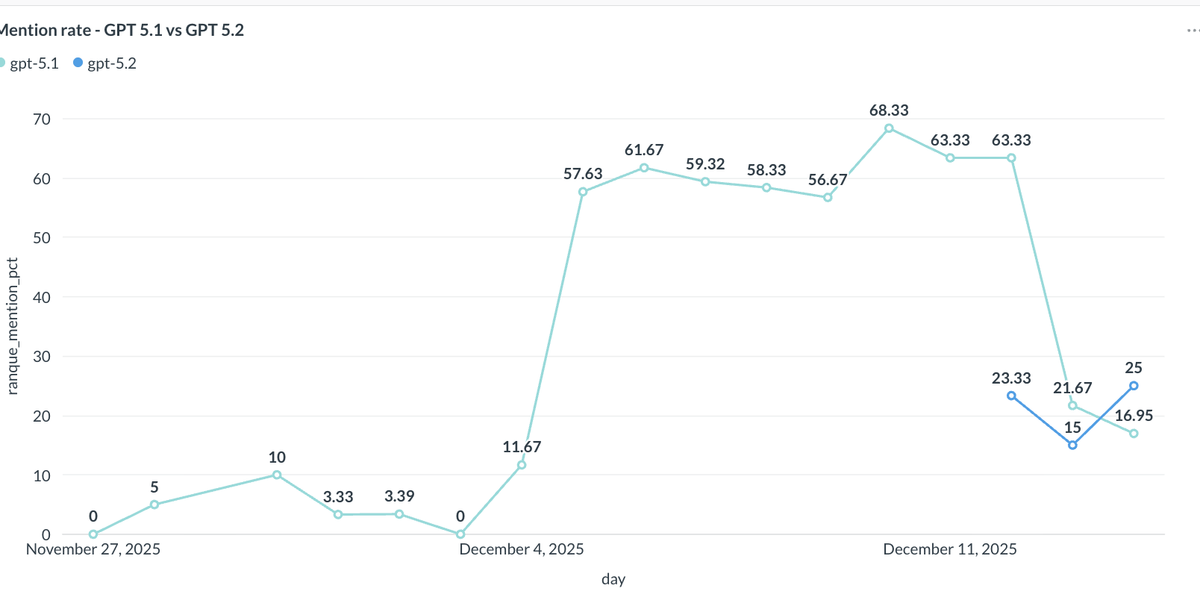
- Mention rate dropped across both models
- GPT-5.1: from a plateau around ~60–68 % mention rate down to the low 20s over the last days.
- GPT-5.2: starting in the same range (~15–25 %) instead of mirroring the old ~60 %+ levels.
Mention rate: GPT-5.2 vs GPT-5.1
So this is not “GPT-5.2 hates Hotel Ranque.”
It looks more like the whole competitive field being re-evaluated. New hotels show up, some disappear, and Hotel Ranque has to fight harder for a mention.
Concrete example: one of the biggest winners in our prompts is Hotel Fabric. It was essentially invisible in our tests before, and is now frequently sitting at #1 where Ranque used to be.
The good news: in our hyper-niche prompt (“chess + yoga + cycling hotel near Ledru-Rollin”), Ranque is still holding its ground. Niche positioning seems stickier than generic “nice boutique hotel in Paris” wording.
3. Signal #2 – GPT-5.2 reads a lot more of the web
When we compare the sources per answer on the same day:
- GPT-5.1
- ~11.8 source URLs per run
- ~8.2 source domains per run
- GPT-5.2
- ~23.9 source URLs per run
- ~14.5 source domains per run
Avg Sources per model per day
So GPT-5.2 is:
- Pulling about 2× more URLs
- Touching ~75% more distinct domains per answer
In practice, that means:
- If you’re a hotel, you’re competing inside a longer bibliography:
- More OTAs & metas
- More review sites
- More travel blogs / listicles
- Small differences in how consistently you show up across these sources will matter more.
Hotel Ranque losing its overall #1 visibility while keeping strong performance on niche prompts fits that story: GPT-5.2 sees more of the “big web,” so generic queries are more crowded.
4. Signal #3 – More “thinking” = higher costs
On the pricing side, we see three stacking effects:
- GPT-5.2 input + output tokens cost ~40% more than GPT-5.1 for the same volume. That's normal. But that's a lot in one month!
- It triggers ~2.3× more web searches in our tests.
- It then uses more sources, which translates into longer answers and even more tokens.
Rough back-of-the-envelope based on our pipeline:
For 1,000 similar hotel prompts, the all-in cost of GPT-5.2 vs GPT-5.1 lands around +120% in total, even before you optimize prompts or trimming.
5. What this means for hotels
A few practical takeaways already:
- AI visibility is not static
- A model upgrade can move you from #1 darling to “sometimes mentioned” overnight.
- If you don’t measure it per model, you’ll only feel it in your bookings, not in your dashboards. Choose your AI visibility tool wisely!
- Niche positioning is more resilient than ever
- The “chess + yoga + cycling near Ledru-Rollin” type of queries still surface Ranque strongly.
- Clear, specific positioning (chess bar, yoga studio, cycling lab, rooftops, pet-friendly, etc.) gives models something to latch onto when answers get more crowded.
- Your presence across the web matters more
- GPT-5.2 is looking at twice as many URLs and many more domains.
- If you’re weak on OTAs, or your direct site is unclear, or your Google profile is messy, the model has plenty of alternatives to pick from.
- Cost vs depth trade-offs are changing
- The default choice “always use the latest, biggest model” now has a very real cost for B2B tools like us.
- But at the same time, this is what users see and use. If you are optimizing for older models, you are optimizing for something outdated.
- The default choice “always use the latest, biggest model” now has a very real cost for B2B tools like us.
6. What we’ll dig into next (and what you can copy)
If you’re running your own AI visibility tests, here’s what we’re planning to investigate next with HotelRank, and what you could mirror:
6.1. New top domains & changing bibliography
- Top domains per model & per day
- Rank domains by how often they appear as sources (Booking, Expedia, official sites, niche blogs, etc.).
- Compare GPT-5.1 vs GPT-5.2:
- Which domains gained the most share?
- Did some OTAs suddenly appear / disappear?
- Rank domains by how often they appear as sources (Booking, Expedia, official sites, niche blogs, etc.).
- Direct vs OTA balance
- For each model, track:
- % of answers citing the official hotel site
- % of answers that only cite OTAs / metas
- Watch if GPT-5.2 is shifting more towards “safer” big intermediaries.
- For each model, track:
6.2. Per-prompt reshuffle
For each of your core prompts (e.g. “romantic boutique hotel Bastille,” “family hotel with connecting rooms,” etc.):
- Compare the ranked list of hotels between GPT-5.1 and GPT-5.2.
- Tag movements:
- “Big winners” (+3 or more positions)
- “Big losers” (-3 or more)
- New entrants / disappearances
6.3. Why GPT-5.1 also moves
The surprising part: GPT-5.1 doesn’t stay frozen. Its mention rate for Ranque also dropped.
This is probably linked to the GPT-5.2 change, as they look very similar in terms of mentions or rank.
In short: assume the environment of GPT-5.1 changed, not just GPT-5.2.
6.4. Stability & volatility metrics
To make this useful for hotels, we’ll be looking at:
- Daily volatility of rank per hotel & per prompt (how jumpy the rankings are).
- Time to recover after a drop (does Ranque bounce back after a few days, or stay down?).
- Cross-model consistency:
- If a hotel is strong across GPT-5.1, GPT-5.2, Gemini and Perplexity, chances are its positioning is structurally solid.
7. For hotel teams: what to do right now
Very concrete checklist:
- Map your core prompts (city × persona × use case).
- Track your AI visibility rank & mention rate per model at least weekly or when models change.
- Invest in clear, differentiated positioning on your site & major platforms.
- Treat GPT model upgrades like algorithm updates in SEO:
- Don’t panic on day one.
- Watch the trend over several days.
- Look for patterns (who replaced you, and why).