
Do Google Reviews and Ratings Influence AI Hotel Visibility? (Nov 2025)
Across 2,000+ hotels and 30,000 AI mentions, this case study shows how Google Reviews and Ratings modestly, but meaningfully, influence whether properties get surfaced in ChatGPT, Gemini, and Perplexity — and what hotels can do about it.
AI and SEO expert at the forefront of AI Search. He analyses models daily and runs hospitality-focused experiments on a database of over 1M prompts, citations and mentions.
Over the past few months, we’ve been measuring how often hotels appear in AI-generated answers across ChatGPT, Gemini, and Perplexity. With thousands of AI citations now mapped to real properties, a natural question emerged:
Do hotels with more Google Reviews — or higher Google Ratings — actually appear more often in AI answers?
In the software world, it has been shown that G2 review counts correlate with more AI citations, even if the effect is small. I wanted to see whether a similar pattern holds in hotels.
So we analyzed over 2,000 hotels with measurable AI mentions in our dataset, cleaned for outliers, ran regressions, and bucketed results to visualize patterns.
Below is what we found.
1. Review Volume: More Reviews → More AI Mentions (But Modestly)
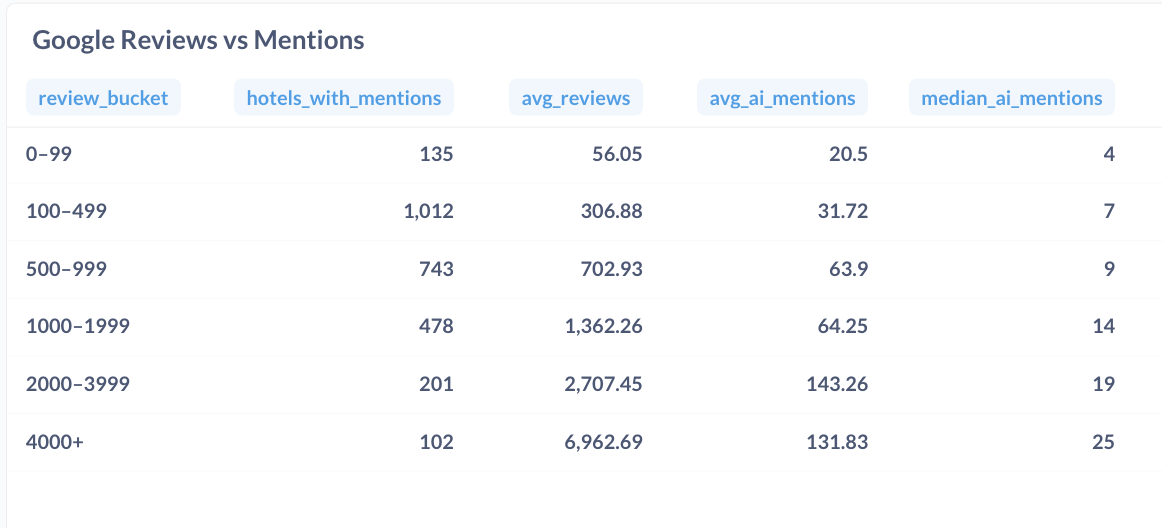
🟩 Hotels with 2,000+ reviews appear ~6× more often in AI answers than those under 100.
On a bucket level, visibility clearly rises with review volume. But when we zoom into the regression — controlling for rating and ranking position — the effect becomes much smaller.
Regression Result (Reviews Only)
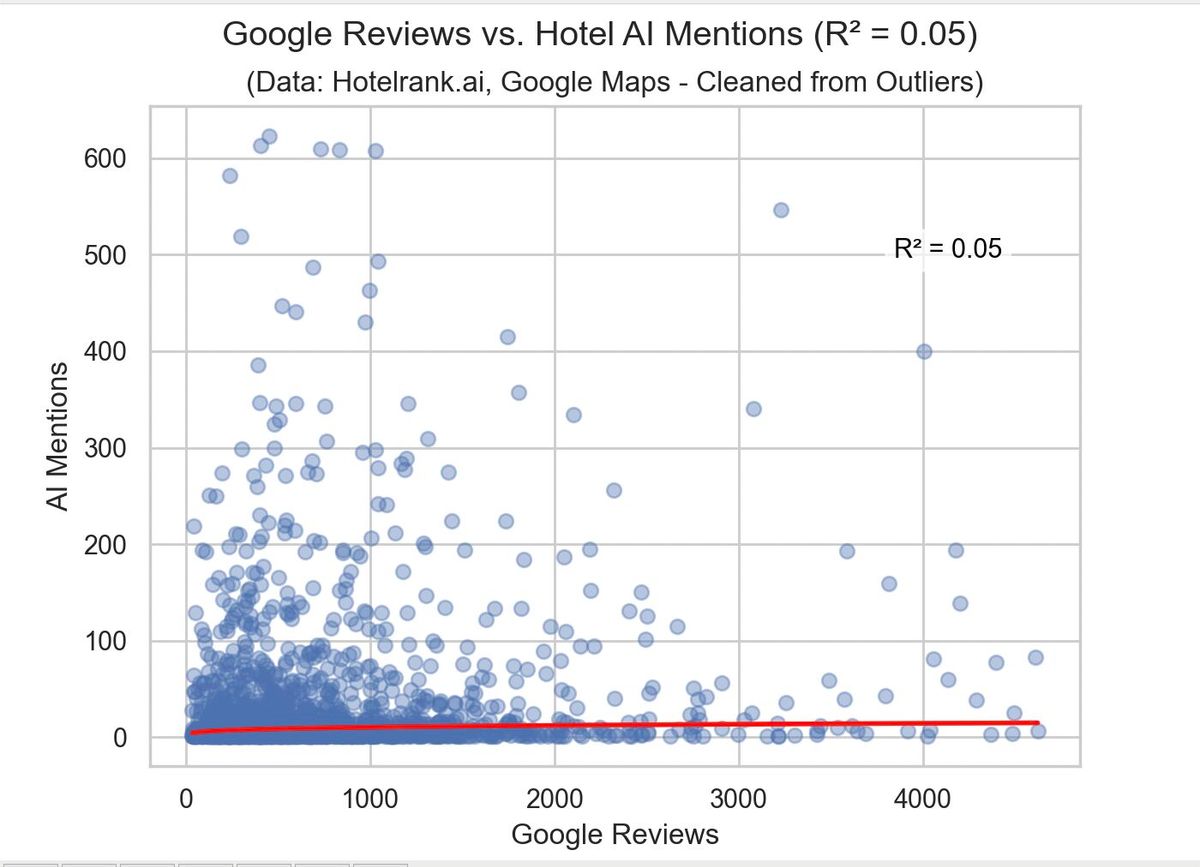
- R² = 0.05
- A 10% increase in Google Reviews → +2.23% AI mentions
- Review count explains only ~5% of visibility variance
This parallels Kevin Indig’s finding for G2:
“Categories with 10% more reviews have 2% more citations".
The signal is small, but real.
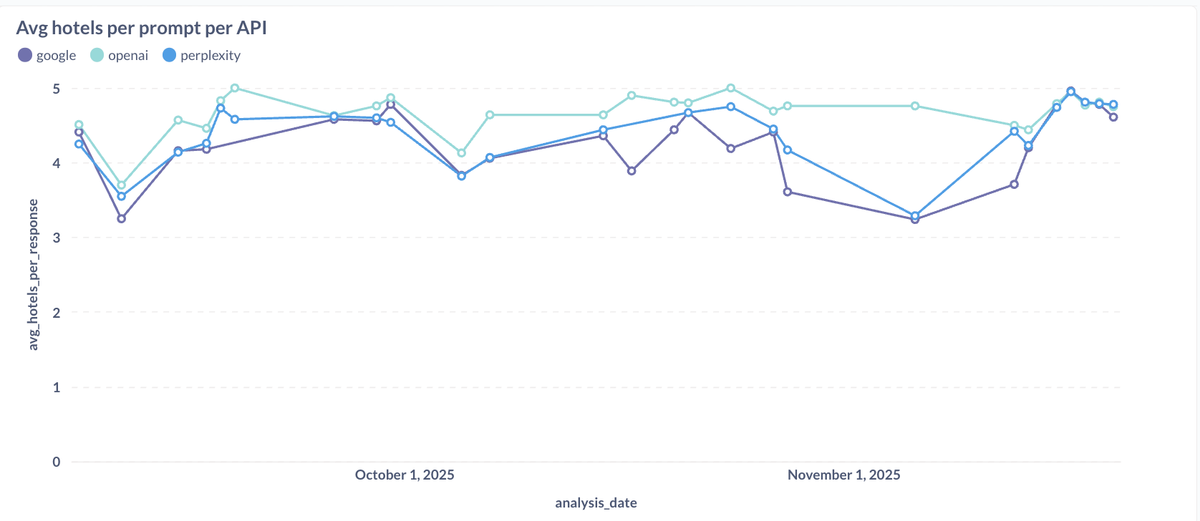
Most hotels receive few AI mentions because AI systems only list 3–5 hotels per query.
In high-visibility destinations (Paris, London, NYC), hundreds of AI queries run every month.
A small visibility lift can move a hotel from:
❌ never recommended
to
✅ occasionally shortlisted
Once you’re in the shortlist, visibility compounds.
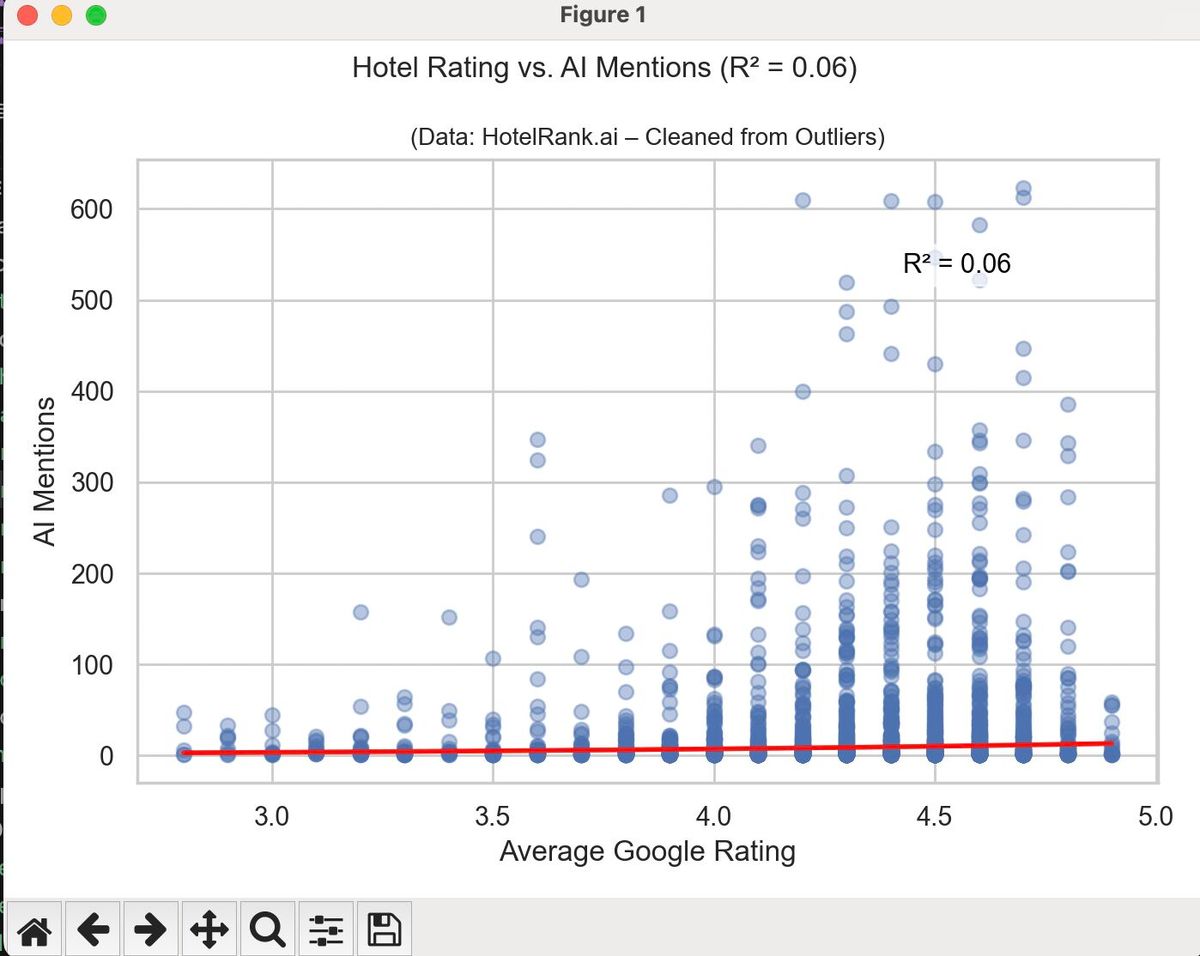
2. Ratings: Better Ratings → Higher Visibility (More Than Review Count)
We repeated the analysis but bucketed hotels by average Google rating rather than volume.
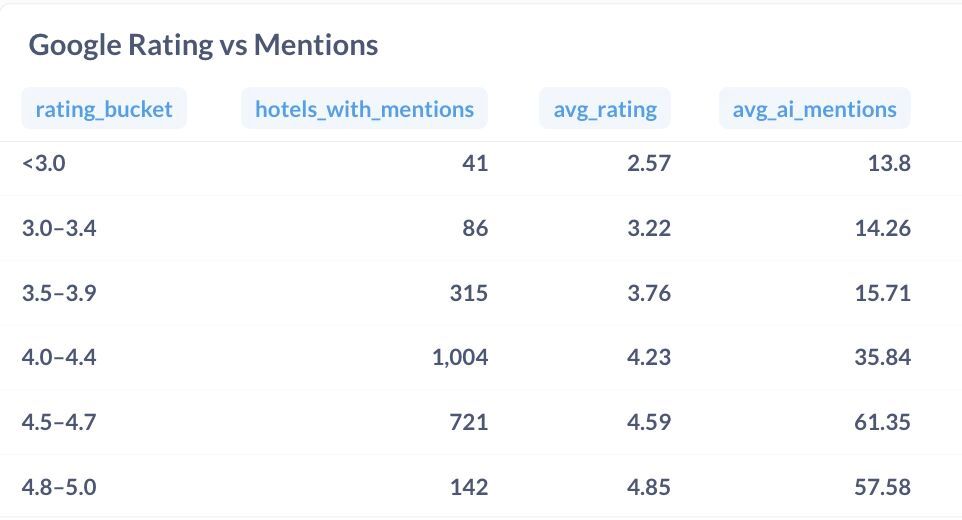
🟩 Hotels rated 4.5★+ receive 4–5× more AI mentions than those below 4.0★.
There’s also a clear step-change at the 4.0 frontier — aligning with consumer expectations.
Full Regression (Controlling for Reviews & Ranking)
log(Mentions) = β₀
+ β₁ * Rating
+ β₂ * log(Reviews)
+ β₃ * log(Rank)
Results:
- β₁ (Rating) = 0.601 (p < 0.001) → +1 rating point ≈ +60% AI mentions → +0.5 rating points ≈ +35% AI mentions
- β₂ (Reviews) = 0.253 (p < 0.001) → +10% reviews ≈ +2.5% mentions
- β₃ (Rank Position) = –0.142 (p < 0.001) → Better-ranked hotels = more mentions
- R² ≈ 0.06
Ratings matter somewhat more than review count — but again, modestly.
3. Why Are These Effects Small? (And Why That Matters)
Like G2 for software, Google Reviews for hotels provide structured, machine-readable signals:
- Recent review velocity
- Popularity
- Quality proxy (rating)
- Category placement
- Cross-web verification
But AI models pull from many signals outside this dataset:
- Brand authority
- Press mentions
- OTA presence
- Social proof
- Location relevance
- Historical web prominence
- Training data composition
So even if reviews explain only 5–6% of visibility variance, that doesn’t make them unimportant
In a winner-take-most system, the hotels that get shortlisted early accumulate surface area over time.
A 2–5% advantage in mentions across hundreds of monthly queries can translate into:
- More visibility
- Higher inclusion rates
- Downstream bookings
AI search doesn’t behave like Google Search.
It behaves like “one-shot” recommendation engines.
Small deltas at the top of the funnel matter.
4. Why Google Reviews Might Influence AI Models at All
AI models need trust anchors.
They look for:
- Verified consumer signals
- Large sample sizes
- Standardized schema
- Consistent formatting
- Strong domain authority
Google Reviews give them:
- Volume (millions of datapoints)
- Velocity (recency)
- Structure (ratings + text + metadata)
- Coverage (globally nearly every property)
Oh and by the way, OpenAI "scrapes" (or works with) Google anyway and use Google Maps identifiers (the place_id) so ... better be good on that.
It’s not that AI models rank hotels by reviews.
It’s that reviews provide a dense relevance signal.
5. Methodology
We analyzed:
- 2,142 hotels with ≥1 measurable AI mention
- Of all standings (2 to 5-stars hotels)
- In different locations in the world
- Across ChatGPT, Gemini, and Perplexity
- 2-month rolling observation window
- 30,000+ mentions
- Google Maps scraped & cleaned
- Regression with log transforms
- Outliers removed (1st–99th percentile)
Controls included:
- Google rating
- Log review count
- Average rank position in AI outputs
6. Limitations
Same as in the G2 research, our results must be interpreted cautiously:
- Low R² means most variance is explained by external factors
- Cross-sectional snapshot, not time series
- Omitted variables: brand strength, website quality, press, OTAs
- Possible non-linearities
- AI models rapidly updating
- Our dataset covers hotels with at least 1 mention (zero-mention hotels excluded) from our own research. This isn't a broad study of 'all' hotels in the world :)
These are associations, not proof of causality.
7. What Hotels Should Do Based on This Research
A. Reinforce your Google presence
- Ask for more (recent) reviews. Offer perks.
- Respond. Professionally. This is content for AIs!
- Fix rating issues
- Clean old or incorrect listings
- Add photos, amenities, descriptions
B. Strengthen your “AI visibility baseline”
- Optimize your website using content from your reviews!
- Push brand mentions across the web
- Improve OTA profiles (indirect signal)
- Build authority via PR and content across AI referenced platforms (Youtube, Reddit, Wikipedia, ...)
C. Track your AI visibility over time
AI models shift frequently.
Hotels that monitor shifts early gain advantage as visibility compounds.
We can help :)
Conclusion
Across 2,000+ hotels, we find:
- More Google Reviews → modestly more AI mentions
- Higher Ratings → stronger correlation with AI mentions
- The predictive power is small (≈5–6%), but strategically important
Visibility in AI search is becoming a distribution channel in itself.
Small lifts in foundational signals — reviews, ratings, authority — can meaningfully affect whether a hotel becomes:
(1) invisible → (2) occasionally recommended → (3) frequently shortlisted
In the early landscape of AI-driven travel planning, these small advantages compound fast.

Nicolas Sitter
AI and SEO expert at the forefront of AI Search. He analyses models daily and runs hospitality-focused experiments on a database of over 1M prompts, citations and mentions.
Co-founder of Hotelrank