
GPT-5 OTA Bias Report — Comparative Insights (Nov 2025)
Evidence from Hotelrank’s 2025 dataset shows GPT-5 mini and nano models systematically amplify OTA visibility, unlike GPT-5’s baseline behavior.
AI and SEO expert at the forefront of AI Search. He analyses models daily and runs hospitality-focused experiments on a database of over 1M prompts, citations and mentions.
Direct Links vs OTAs per GPT-5 model (%), November 2025 Update
Methodology
This study is based on HotelRank.ai’s proprietary analysis of over 10,000 prompts designed to reflect real-world hotel search scenarios.
To capture a wide range of user behaviors, we defined a consistent panel of representative traveler personas:
- Couples
- Elderly travellers
- Families with children
- Group Business travelers
- Leisure groups
- Luxury travelers
- Solo Business travelers
- Solo leisure travelers
Each persona was used to query AI systems across a variety of destinations and contexts (romantic weekend, family stay with a pool, boutique hotel near a convention center, etc.).
We focused on 3‑star, 4‑star, and 5‑star hotels (even though hotel standards are not always consistent across countries).
Here is the list of cities:
- New York
- Los Angeles
- Miami
- Paris
- London
- Rome
- Barcelona
- Amsterdam
- Berlin
- Dubai
- Bangkok
- Tokyo
- Shanghai
- Hong Kong
- Singapore
- Sydney
- Melbourne
- Cape Town
- Cairo
- Istanbul
- Athens
- Mexico City
- Rio de Janeiro
- Buenos Aires
- Toronto
Model Comparison Protocol
We submitted the same prompts to a selected set of five GPT-5 model variants, including:
- GPT-5
- GPT-5 nano
- GPT-5 mini
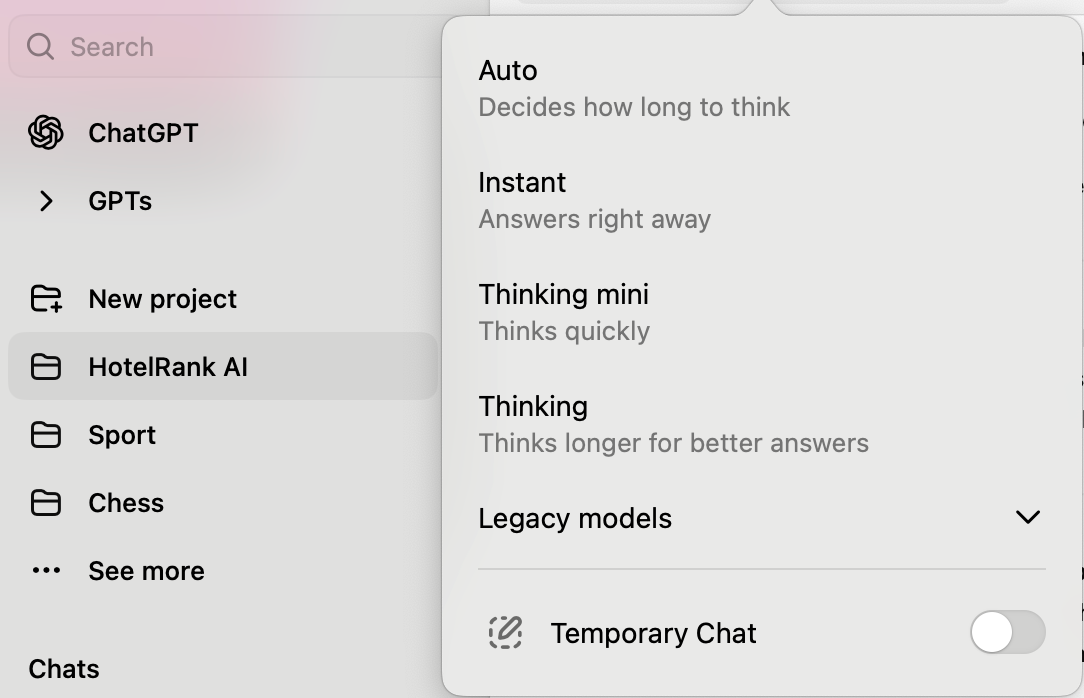
These models correspond to the versions deployed in the ChatGPT interface (GPT-5 = Thinking, GPT-5 mini = Thinking Mini), while GPT-5 nano represents the fastest and most efficient version of GPT-5 available via API.
For each AI-generated response, we extracted and classified:
- All hotel-related links, broken down into:
- OTA (Online Travel Agencies) — e.g., Booking.com, Expedia, Hotels.com
- Direct hotel websites
- Model (name)
- Prompt context (persona, city)
Below are our results.
The more the model “thinks,” the more it links to direct hotel websites
In a previous study on link hallucinations, I referenced OpenAI’s September 5th article, which highlighted that GPT-5 hallucinates significantly less—though it still occasionally invents non-existent domains.
Similarly, GPT-5 outputs almost exclusively direct hotel links (over 95%).
By contrast, mini and nano models include OTA links in nearly 30% of cases, revealing a clear shift in behavior based on model size and reasoning depth.
Share of OTA Links by GPT Model (%)
But what’s the real impact for users?
There’s no public data on how frequently each GPT-5 variant is used, but here’s what we can reasonably assume based on performance and integration patterns:
- GPT-5 Nano
No direct impact on users — but likely a significant indirect one. As the fastest and cheapest variant, Nano is often used as the underlying engine for travel agents and API-based assistants.
However, its simplicity means it struggles with more complex prompts — such as detailed hotel searches. This may lead to generic, OTA-heavy recommendations.
- GPT-5 Mini
This is likely the default model for travel-related queries in ChatGPT’s consumer interface. It handles simple requests efficiently.
Given its streamlined nature, it’s not surprising to see up to 30% OTA links in its responses — the model tends to default to mainstream sources to go straight to the point.
- GPT-5 (full model)
This is the version powering advanced travel research — cross-referencing data, performing live web lookups, and handling nuanced requests.
And that’s where the opportunity lies: almost all hotel links are direct. For hotels looking to optimize revenue management, GPT‑5 “Thinking” offers a high-potential channel for direct bookings.
The higher the star rating, the fewer OTA links appear in the AI’s responses
Interestingly, a strong bias emerges in the AI responses depending on the hotel’s star rating:
- A heavy reliance on OTAs (nearly 50%) for 3-star hotels in GPT‑5 mini and nano
- In comparison, GPT‑5 (full) includes OTAs in only 12% of its responses
- The trend continues — though to a lesser extent (~30%) — for 4-star hotels
- And it almost disappears entirely for 5-star hotels
It’s worth noting that some 5-star properties are not listed on OTA platforms, or only appear on a limited number of them.
In France, as of 2024, 3-star hotels represented 48.6% of all classified hotels, and 4-star hotels made up 19.33% (source: INSEE).
This means the observed bias disproportionately impacts the majority of hotels, especially those in the mid-range — and likely extends to 2-star properties as well.
Share of OTA Links by GPT Model and star rating (%)
The type of hotel — and by extension, its budget category — also has a clear impact on the rate of OTA links in AI responses
Similarly, the most budget-friendly accommodations — such as hostels, budget hotels, aparthotels, and eco-lodges — show the highest rates of OTA links, often exceeding 50% in GPT‑5 mini and nano models.
Conversely, luxury hotels, resorts, and boutique hotels are much less frequently linked through OTAs, indicating a clear correlation between price positioning and the AI’s tendency to favor direct versus third-party links.arthotels et eco-lodges — affichent les taux les plus élevés de liens OTA, dépassant souvent 50 % dans les modèles mini et nano.
Share of OTA links by hotel type and model (%)
This also highlights a broader issue of "algorithmic fairness": the lower-budget properties — often the ones most reliant on disintermediation — are also the most confined to OTA monopolies in AI-generated responses.
OTAs for the easy clicks, direct for the serious choices
Leisure-related queries show the highest OTA link rates, while business travelers and elderly users receive significantly fewer OTA links.
This suggests a clear bias based on customer segments, which could pose a strategic challenge for hotels depending on their target audience.
Share of OTA links by persona and models (%)
Booking, the king
Even though Booking.com is likely the most well-known OTA, the numbers are striking: 85% of all OTA links generated by the models point to Booking.com.
Does this hint at a potential partnership between OpenAI and Booking?
We’ll probably find out soon — especially with the recent launch of Instant Checkout and upcoming Shopify integrations, signaling a move toward more transactional AI experiences.
Top OTA domains
Conclusions
- The more the model thinks, the fewer OTA links it provides.
- The higher the hotel’s star rating, the fewer OTA links it provides.
- The higher the budget, the fewer OTA links it provides.
In short: reasoning, rating, and price all reduce reliance on OTAs in AI responses.
Beyond the Findings
How can we explain these biases?
Here are a few hypotheses:
- Training data skewed toward commercial sources, with OTA links more prevalent in general-purpose datasets
- Limited reasoning and contextual understanding in smaller, lightweight models — leading them to default to common sources
- Over-optimization for speed and simplicity, favoring quick, standardized answers rather than nuanced recommendations
- Weaker digital presence and brand visibility among lower-tier properties, making direct links less likely to surface organically

Nicolas Sitter
AI and SEO expert at the forefront of AI Search. He analyses models daily and runs hospitality-focused experiments on a database of over 1M prompts, citations and mentions.
Co-founder of Hotelrank