
The Hotel Ranque App: Direct Booking inside ChatGPT
Using a ChatGPT app wired to Hotel Ranque, I prototype a full DIRECT-booking flow from natural-language search to room selection and confirmation, and share what this means for hotels in AI Search.
AI and SEO expert at the forefront of AI Search. He analyses models daily and runs hospitality-focused experiments on a database of over 1M prompts, citations and mentions.
Episode 2 – What if guests could book your hotel inside ChatGPT?
Last week, I showed that a hotel can rank in ChatGPT in roughly 48 hours.
This was about the search and discovery layer:
How quickly can an LLM understand a new hotel with web search, what it offers, and when it should recommend it?
This week, I went one step further down the funnel:
What happens at the transaction layer, when the guest is ready to book?
So I wired Hotel Ranque into a ChatGPT app and tried to imagine what direct booking could look like inside the assistant itself.
Disclaimer:
There are only a handful of Apps available TODAY in ChatGPT, outside the EU, but more will come. This prototype runs via Developer Mode.
Still, the shape of the future is already visible.
From search query to direct booking
Imagine a guest typing:
- “best boutique hotel with specialty coffee near Paris Bastille”
- “find me hotels for chess yoga cycling in paris near ledru rollin”
- "Show me the rooms and availabilities at Hotel Ranque in Paris”
They can be discovering or looking for a specific brand (think loyalty).
They are describing a combination of interests, location and vibe.
Step 1 – ChatGPT recommends Hotel Ranque
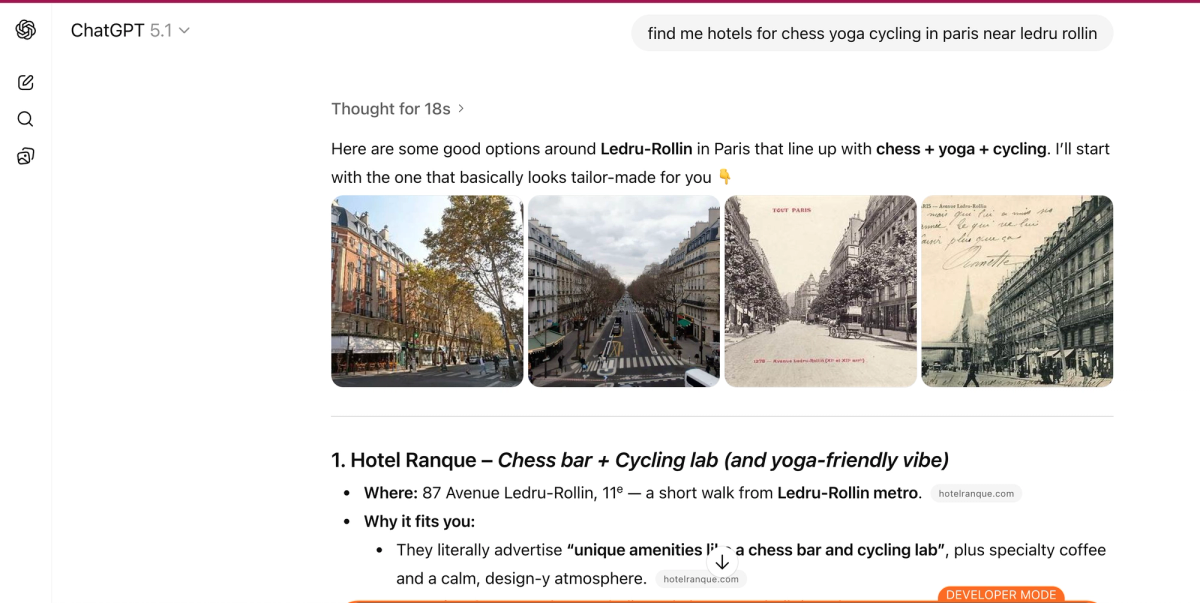
ChatGPT can surface Hotel Ranque because of:
- The address near Ledru-Rollin and Bastille
- The specialty coffee corner
- The chess bar, cycling lab and yoga studio
- The fact that it is a small, three-star boutique hotel
- Or, simply, the fact to ask for it (regular customer persona)
So the assistant answers the query with a proper explanation:
- Why the hotel fits
- How the neighbourhood looks
- What makes the experience different from a generic chain
And it cites the hotel’s website as a source.
Step 2 – The user asks to see rooms and availability
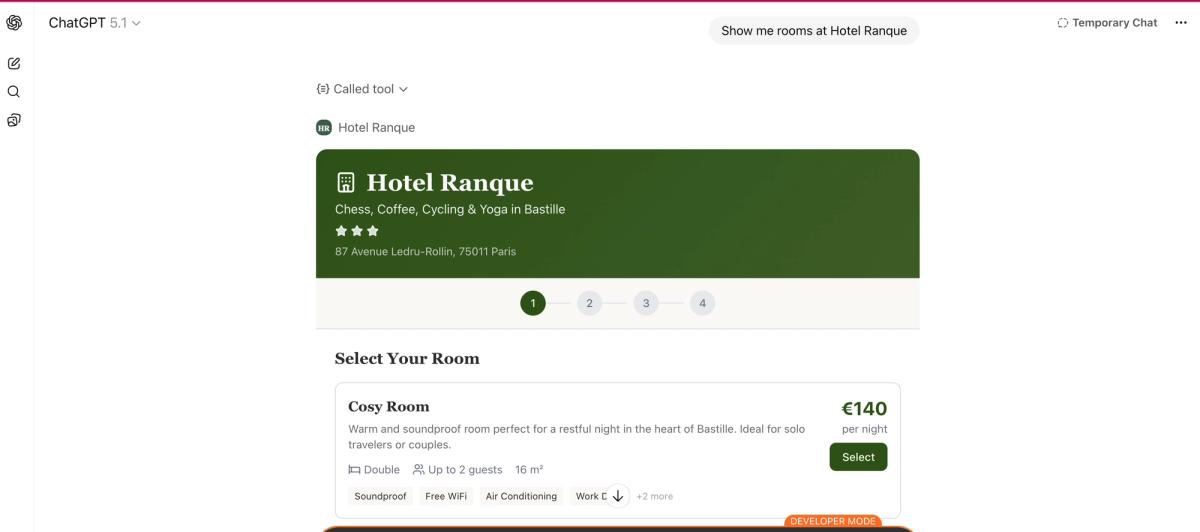
The guest then does what most people naturally do next:
“What’s the price for two nights next week?”
“What are the different room types?”
At that point, a mini booking engine appears inside the chat.
The ChatGPT app for Hotel Ranque takes over the transactional part, while staying within the conversation.
Step 3 – The Hotel Ranque app manges the booking
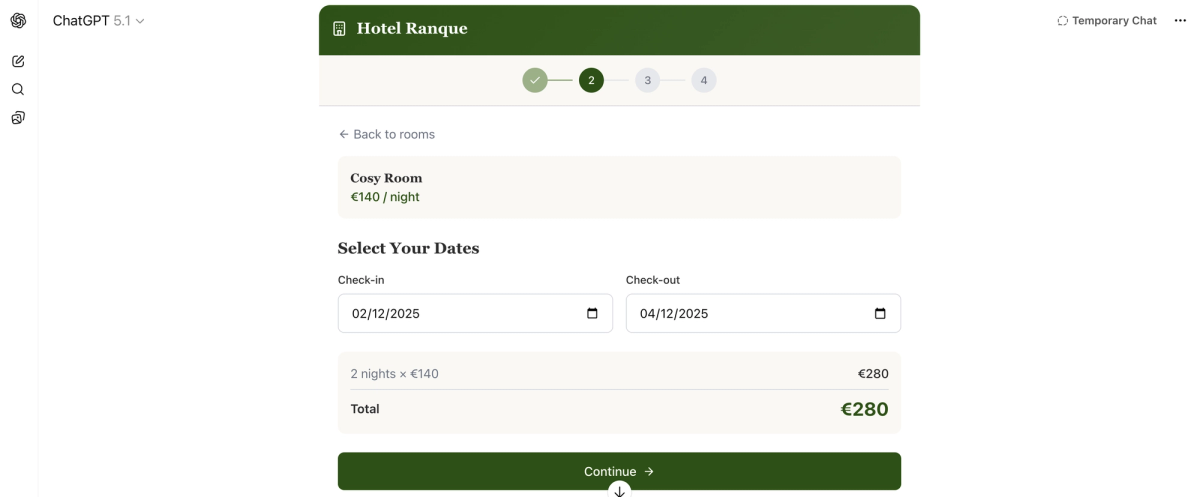
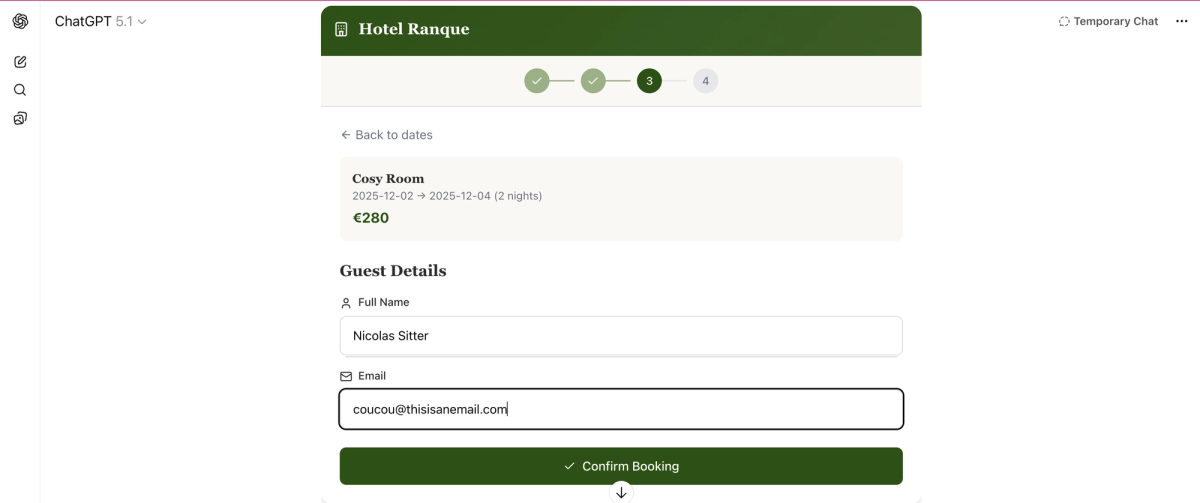
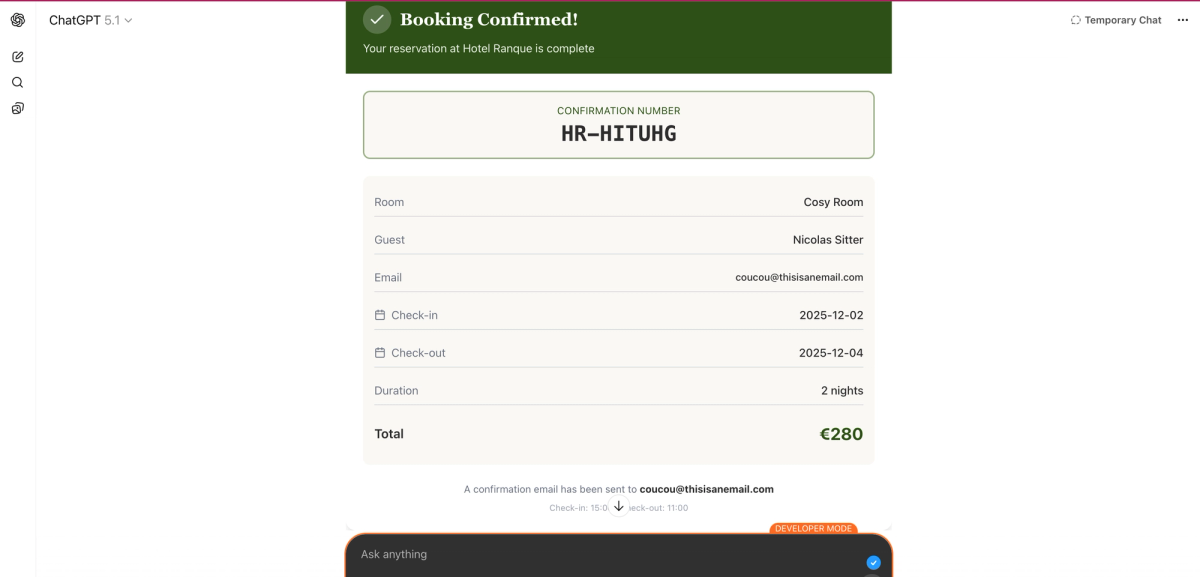
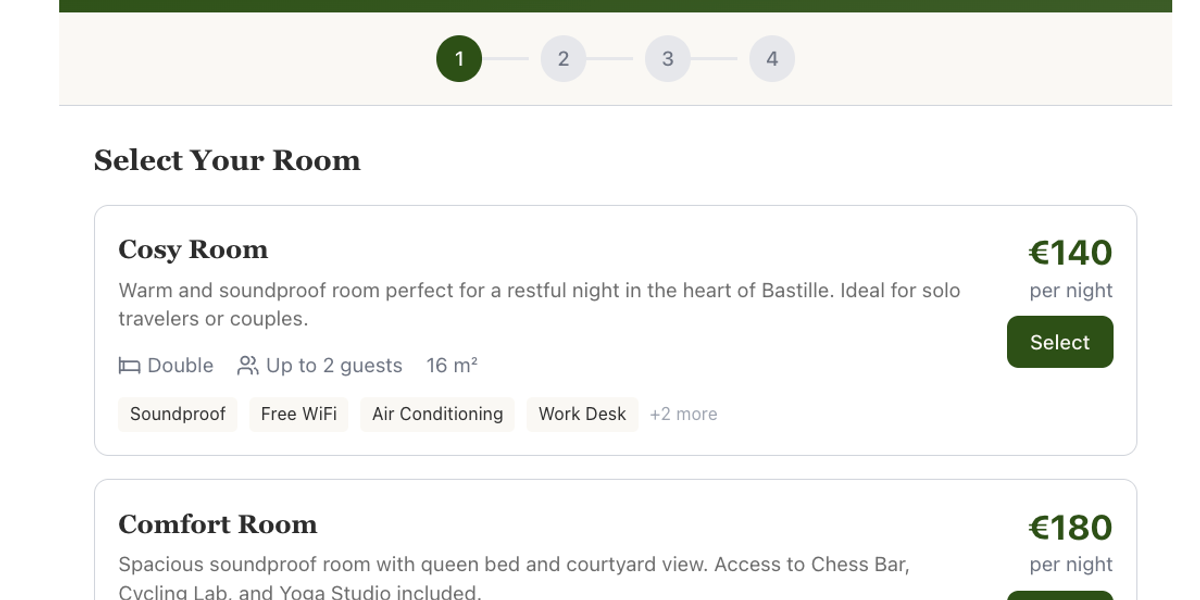
The flow is deliberately simple:
- Choose your room
- Cosy / Comfort / Superior / Family
- Room description, size, amenities and price per night
- Pick your dates
- Check-in and check-out
- Automatic calculation of total price
- Add name and email
- Enough to create a booking in the PMS
- Receive a confirmation number and email
- A clear confirmation screen with dates, room and total amount
(I didn't focus on payment here for demo purposes, but you get the point)
All of this happens without leaving ChatGPT.
No filters.
No tab jungle.
No dancing between three OTAs and two metas to find the best price.
The best price is going direct!
Why this matters for hotels
The pattern is simple but powerful:
“Find me a hotel near X with Y and Z”
→ The LLM finds it, explains it, and can book it for you.
That raises new questions and opportunities.
How will apps be surfaced?
There is a discovery problem for apps themselves:
- Which hotel app is shown or suggested first?
- Will apps be promoted with something that looks like sponsored placements? (probably at first)
- How will the assistant arbitrate between a generic OTA app and a specific hotel or chain app?
There is clearly an ecosystem and an advertising layer waiting to be built here.
How can hotels plug in their own booking system?
The second question is technical and strategic:
- Can a hotel or group propose its own booking app directly?
- Will they have to go through OTAs or large vendors?
- How much control will they have over pricing, policies and upsells?
The early signs are that multiple routes will coexist:
- OTA apps such as Booking and Expedia are already live outside the EU, initially with affiliation.
- Hotel-tech providers are building connective tissue, such as Connect AI from The Hotels Network / Lighthouse.
- Large groups like Accor are experimenting with their own assistants and tools.
The common thread is that booking becomes an action the assistant can perform, not just a link it can show.
What LLMs seem to prefer today
My experiments so far suggest that when a query requires more “thinking” or when the user explicitly asks for the best option or the best price, LLMs tend to favour direct links (see here):
- Hotel websites often advertise best-price guarantees or exclusive perks
- Structured data and FAQs give the model very clean information
- When there is a clear entity with a clear site, it becomes a natural answer
At the same time, OTAs remain important:
- They provide density of reviews and photos
- They help disambiguate hotel names and locations
- They give models extra context and social proof
It is not “direct versus OTAs” so much as “direct plus OTAs, orchestrated by the assistant”.
Three priorities for hotels
If the assistant becomes the layer that connects discovery and booking, hotels need to prepare on three fronts.
1. Entity clarity
The model needs to know exactly who you are.
- Google Business Profile with accurate categories, photos and attributes
- A website that clearly states address, neighbourhood and brand
- Structured data: not only contact details, but room sizes, amenities, audiences, experiences
Being on OTA platforms still matters because AIs use them as sources.
But the core entity should start from your own website and GMB.
2. Discovery structured content
You cannot rely on the assistant to improvise your positioning.
- Create pages and FAQs that explicitly answer “hotel near X for Y type of traveller”
- Make your unique value proposition concrete:
- For example, chess bar, cycling lab, specialty coffee and yoga in the same space are specific to Hotel Ranque
This is your opportunity to define your niche and give the model something interesting to latch onto.
3. Assistant-ready booking
The last piece is to let the assistant do something with the recommendation.
- An MCP tool or app for your hotel that can:
- Check availability
- Return rates and room types
- Accept Payments through the Commerce Protocol
- Create bookings
This can be wired through:
- OTAs, if they expose the right APIs
- Large vendors that sit between the assistant and your PMS
- Or your own stack, if you have the technical capacity
Booking flows are being built right now by hotel-tech companies, by OTAs and by big hotel groups. The question is not whether assistants will book, but who will own the relationship at that moment.
Where this might go next
I do not know exactly how all of this will unravel.
What is clear is that:
- The discovery part and the transaction part are now deeply connected
- The assistant is in a good position to orchestrate both
- Hotels that invest early in clarity, content and connectivity will be easier to surface and easier to book
Hotelrank.ai researches all this on a daily basis:
- How assistants discover a new hotel
- How they talk about it
- How they might book it
- And what actually moves the needle in real AI trip planning
Loom demo: https://www.loom.com/share/73566b275c4540d0a3215fbd9daa9f6f