
[Nov 25] OTA Bias in Google Gemini Models
Gemini consistently cites OTAs in 37–45% of its travel-related answers across all model versions. Booking.com leads by a wide margin (80%) — with Expedia and other OTAs trailing far behind.
AI and SEO expert at the forefront of AI Search. He analyses models daily and runs hospitality-focused experiments on a database of over 1M prompts, citations and mentions.
Share of OTA Links by Gemini Model (%)
Methodology
This study is based on HotelRank.ai’s proprietary analysis of over 10,000 prompts designed to reflect real-world hotel search scenarios. They are the same prompts as our former analysis on ChatGPT models.
To capture a wide range of user behaviors, we defined a consistent panel of representative traveler personas:
- Couples
- Elderly travellers
- Families with children
- Group Business travelers
- Leisure groups
- Luxury travelers
- Solo Business travelers
- Solo leisure travelers
Each persona was used to query AI systems across a variety of destinations and contexts (romantic weekend, family stay with a pool, boutique hotel near a convention center, etc.).
We focused on 3‑star, 4‑star, and 5‑star hotels (even though hotel standards are not always consistent across countries).
Here is the list of cities:
- New York
- Los Angeles
- Miami
- Paris
- London
- Rome
- Barcelona
- Amsterdam
- Berlin
- Dubai
- Bangkok
- Tokyo
- Shanghai
- Hong Kong
- Singapore
- Sydney
- Melbourne
- Cape Town
- Cairo
- Istanbul
- Athens
- Mexico City
- Rio de Janeiro
- Buenos Aires
- Toronto
Model Comparison Protocol
We submitted the same prompts to a selected set of three Google Gemini model variants, including:
- Gemini 2.5 Flash
- Gemini 2.5 Flash Lite
- Gemini 2.5 Flash Preview 09-2025
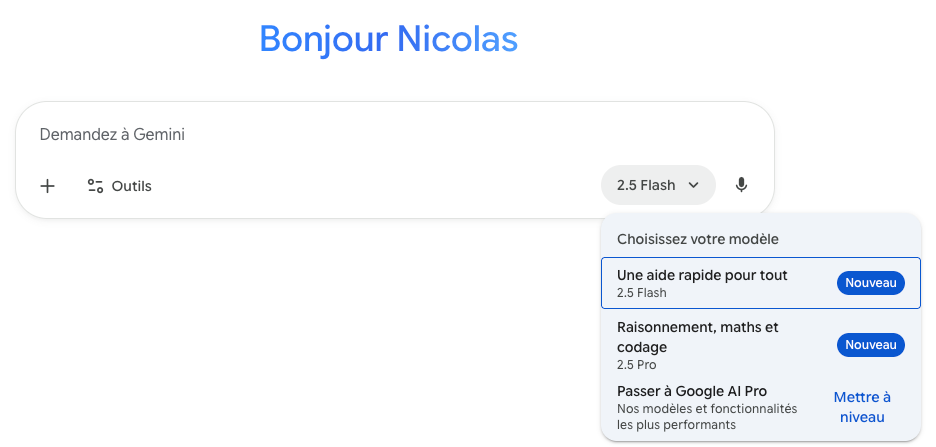
Gemini 2.5 Flash corresponds to the version deployed in the main Gemini interface.
The other models are frequently used through API calls by third-party services, such as AI travel agents.
For each AI-generated response, we extracted and classified:
- All hotel-related links, broken down into:
- OTA (Online Travel Agencies) — e.g., Booking.com, Expedia, Hotels.com
- Direct hotel websites
- Model (name)
- Prompt context (persona, city)
Below are our results.
No major differences across models — Google tends to favor OTAs more than ChatGPT
Whereas GPT-5 almost exclusively returns direct hotel links (>95%), as shown in our previous analysis, this is not the case for Gemini.
All Gemini models include a significant share of OTA links — between 37% and 47%.
It would be interesting to test with Gemini Flash Pro, to see whether a more advanced “reasoning” capability would lead to a much lower OTA rate.
Share of OTA Links by Gemini Model (%)
Share of OTA Links by GPT Model (%)
The higher the star rating, the fewer OTA links appear in the AI’s responses
Like ChatGPT, Gemini models show a strong bias depending on the hotel category.
- 3-star hotels: heavy reliance on OTAs — from 58% to 76% of the links.
- In comparison, GPT-5 lists only about 12% OTA links for the same segment.
- 4-star hotels: the effect remains, though less pronounced — 35% to 55% OTA links.
- 5-star hotels: the bias drops — under 10% OTA links
- partly because some luxury properties are not listed (or less present) on OTAs.
- partly because some luxury properties are not listed (or less present) on OTAs.
In France, as of 2024, 3-star hotels represented 48.6% of all classified hotels, and 4-star hotels made up 19.33% (source: INSEE).
This means the observed bias disproportionately impacts the majority of hotels, especially those in the mid-range — and likely extends to 2-star properties as well.
Share of OTA Links by Gemini Model and star rating (%)
The type of hotel — and by extension, its budget category — also has a clear impact on the rate of OTA links in AI responses
Similarly, the most affordable properties — hostels and budget hotels — show the highest share of OTA links, often exceeding 65%.
In contrast, luxury hotels, resorts, boutique hotels, and spa hotels are much less frequently cited through OTAs.
Gemini - Share of OTA links by hotel type and model (%)
This also highlights a broader issue of "algorithmic fairness": the lower-budget properties — often the ones most reliant on disintermediation — are also the most confined to OTA monopolies in AI-generated responses.
Luxury and group-oriented business hotels show a much lower presence of OTA links
Leisure travel shows the highest OTA rates — but so do solo business trips, which is a key difference compared to ChatGPT.
This suggests there’s also a bias based on traveler segments, which could represent a strategic challenge for hotels depending on their target clientele.
Gemini - Share of OTA links by persona and models (%)
Booking — still the undisputed reference point.
Even though Booking.com is arguably the most well-known OTA, the numbers are striking: 80% of all OTA links point to Booking.
However, other OTAs — especially Expedia — perform better than in ChatGPT.
With ChatGPT Apps on one side and Google’s ad ecosystem on the other,
the question is: what comes next for distribution visibility in AI?
Top OTA domains in Gemini Models
Conclusions
- Gemini consistently includes OTA links — between 37% and 47%.
- The higher the hotel category, the fewer OTA links appear.
- Similarly, the higher the traveler’s budget, the fewer OTAs are cited
- although this pattern is less pronounced than in ChatGPT.
- although this pattern is less pronounced than in ChatGPT.
Beyond the Findings
How can we explain these biases?
Here are a few hypotheses:
- Google Hotels, Google Ads, and Google Maps all play a role in what Gemini surfaces.
- In short: if you pay or have strong visibility in Google’s ecosystem, you appear more.
- This helps explain why Gemini features more OTA links than ChatGPT — OTAs invest heavily in SEA, distribution, and structured data.
- It would be worth testing whether a more advanced reasoning model (e.g., Gemini Flash Pro or a more constrained prompt) would, like GPT-5, reduce OTA prevalence by better understanding travel context.
- The same pattern holds across segments
- Hotels with weaker digital presence or brand image — often in lower categories — are more easily replaced by OTAs in results.
- Meanwhile, premium and well-branded hotels perform significantly better, even within Gemini.

Nicolas Sitter
AI and SEO expert at the forefront of AI Search. He analyses models daily and runs hospitality-focused experiments on a database of over 1M prompts, citations and mentions.
Co-founder of Hotelrank